In April 2026 we ran the first Fallow journey — six travellers, six nights, one valley on the edge of the Great Himalayan National Park. I had planned the week carefully. A walk to a hamlet for lunch. A waterfall hike with a cleanup along the way. A morning of birding. A traditional Himachali meal cooked from the valley's own produce. I knew, on paper, exactly what would happen.
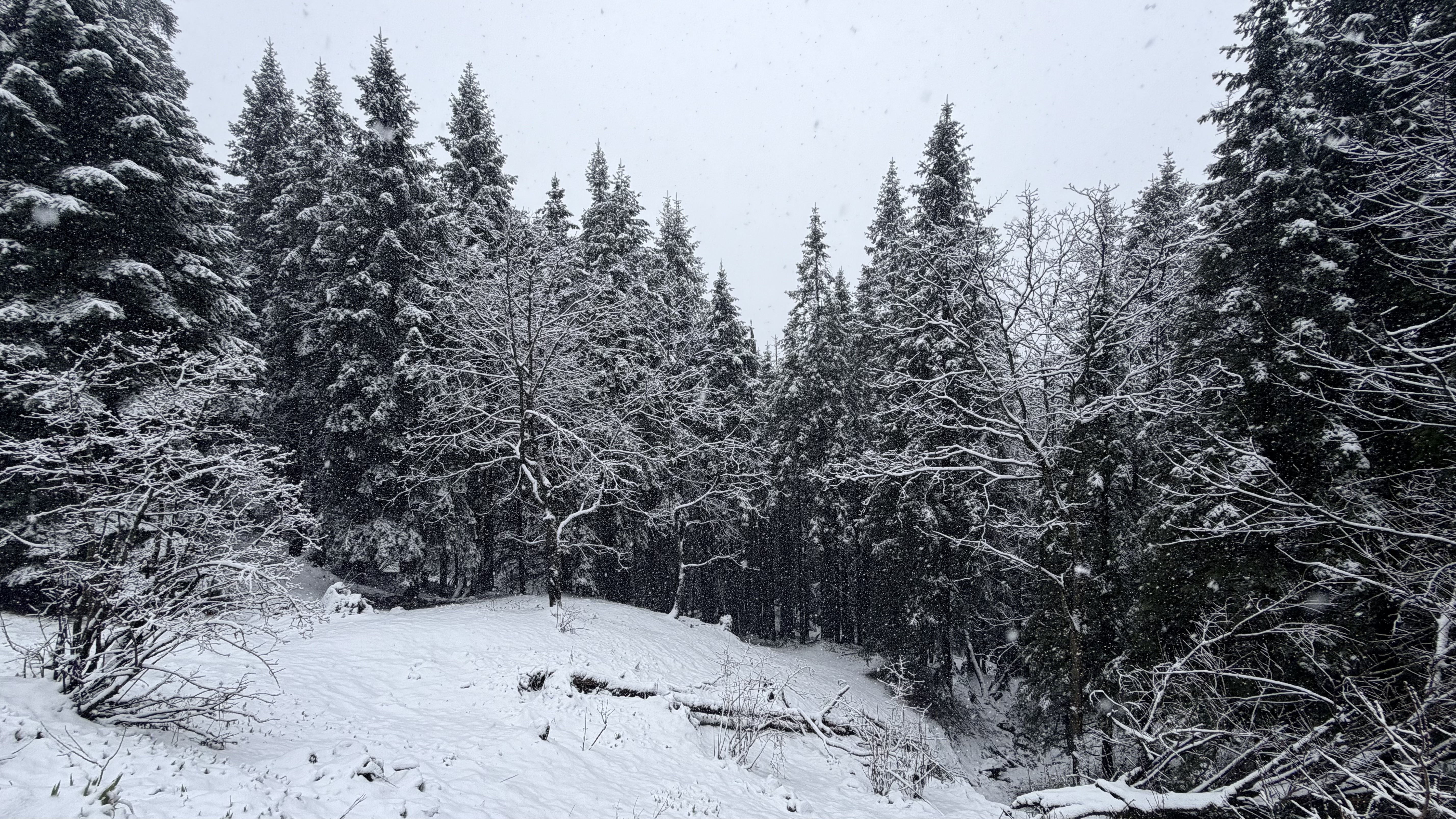
And then, on a day that was supposed to be birdwatching, the rain had other plans. By six in the morning it was still coming down; by seven we had called it off. I stood looking at the grey sky and had a thought: if it's been raining here for days, it must be snowing somewhere above us. I checked the forecast for a higher pass — the reading showed 0°C. I booked a vehicle, and by half past nine we were driving up into the clouds.
A few kilometres before the pass, snow appeared on the verges as rainfall got converted into snowfall. A little further, the driver stopped — heavy snowfall, no snow tyres, and the road ahead was buried. We got out and walked in the snowfall. The trees were entirely white. Fresh snow was still falling all around us. The group stood in it like children who had never seen winter before, and that morning — nowhere on the original itinerary — became the thing several of them named, weeks later, as the highlight of the trip.
I have thought about that a lot since. You spend months designing a journey, and then the parts people carry home are the parts that arrived on their own. This is not a failure of planning. It is the whole point. You can't manufacture the snow. What you can do is make sure people are somewhere worth being when it falls, with nowhere they urgently have to be, and enough quiet around them to notice it happening.
The school, and a kind of childhood
One morning we walked up through apple orchards to a small hamlet and visited the village school. I was nervous about it — these things can curdle into something performative, outsiders looking in. It didn't. One traveller later said it was like being returned to her own childhood. The children were not a spectacle and we were not benefactors; for an hour everyone was just in the same room, slightly shy, laughing at the same things. That hour did more for the group than any view did.
This is what I mean by community as a pillar rather than a stop. We didn't go to see the village. We went to spend time in it, on its terms, and then we left without taking anything that wasn't offered.
The valley, the mountains, the river, the community — it all heals you in ways you wouldn't have seen coming.
That line is from Kishori, who was on that first trip. I keep coming back to the phrase wouldn't have seen coming, because it describes the mechanism exactly. Nobody arrived in Tirthan to be healed. They arrived tired, urban, a little sceptical, phones full. The healing — if that's even the right word — was a side effect of staying still long enough in a place that runs at a different speed.
The river you stop hearing
The Tirthan is always there. It roars and pools and goes quiet by turns, and for the first day or two it is simply loud. Then something happens that everyone who stays by a river knows: you stop hearing it as noise and start hearing it as the room you're living in. By day three, people were falling asleep to it and waking to it, and on the last morning more than one person said the thing they'd miss most was the sound.
We built our days around boulders and forest trails and an hour, every day, of doing nothing in particular. Gurpreet put it best afterwards: the moments of solitude on the river boulders had become a core memory. Not the big set-pieces. The solitude.
The only complaint, more or less unanimous, was that the week went too fast. I'll take that. It is the right complaint to have about a place — and the reason we go back.
— Kunal Shah, founder of Fallow Journeys. The next Tirthan departure is open for 6–12 Dec 2026. You can read the full journey here.
Get Field Notes in your inbox — slow writing from the landscapes we travel through, never more than twice a month.